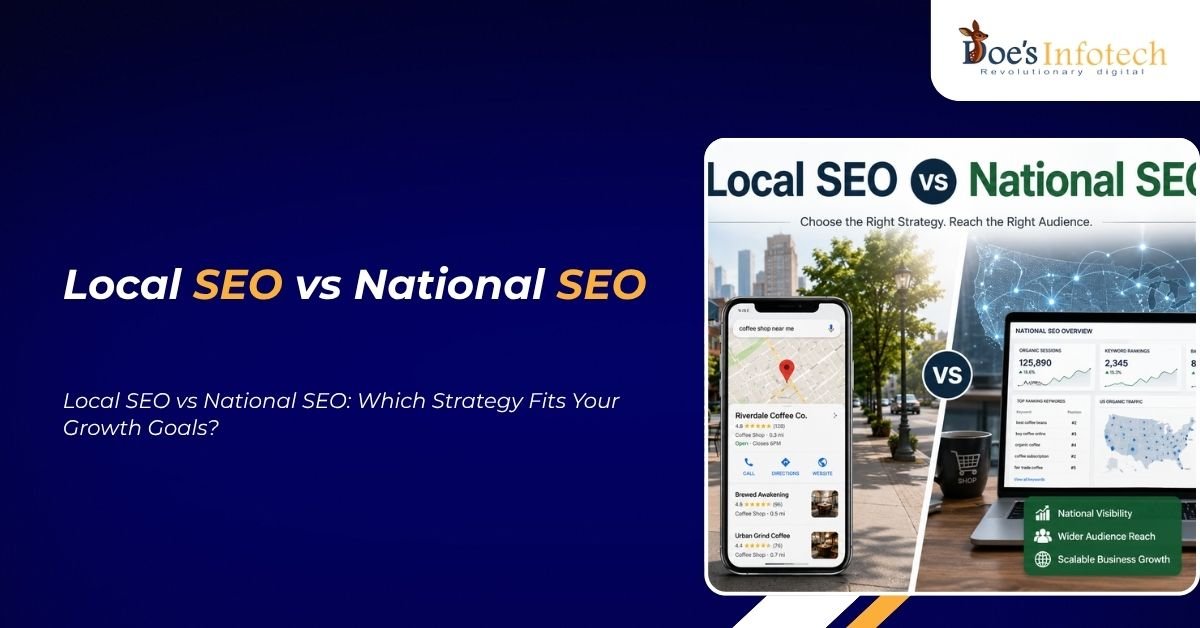
Local SEO vs National SEO: Which Strategy Fits Your Growth Goals?
Search visibility is not one-size-fits-all. A bakery in Austin does not need the same SEO plan as an ecommerce brand selling coffee equipment nationwide. Both want rankings, traffic, and revenue, but the path looks different.
That is the practical value of understanding local SEO vs national SEO. The choice affects keyword research, content planning, link building, technical priorities, reporting, and budget. Pick the wrong approach, and you may spend months chasing traffic that looks impressive but rarely converts.
The smartest strategy starts with a simple question: where does your best customer need to be when they search?
What Is Local SEO?
Local SEO helps a business appear for searches tied to a specific location or service area. It matters most for companies that serve customers face to face, visit customers at their location, or depend on regional demand.
Think dentists, restaurants, law firms, home service companies, gyms, clinics, salons, accountants, real estate agencies, and multi-location retailers. These businesses need visibility in Google Maps, the local pack, city-based organic results, and “near me” searches.
A local strategy usually focuses on:
- Google Business Profile optimization
- Local landing pages
- Reviews and reputation signals
- Name, address, and phone consistency
- Local citations and directory listings
- Location-specific content
- Community backlinks
Local SEO is powerful because it meets people at a high-intent moment. Someone searching “emergency plumber near me” or “family dentist in Phoenix” is usually much closer to booking than someone reading a broad educational guide.
What Is National SEO?
National SEO aims for searchers from a broader market, typically the entire country. Ideal for non-location-dependent businesses like ecommerce stores, SaaS businesses, online publishers, national franchises, manufacturers, consultants, marketplaces and digital services.
National campaigns target high-volume keywords that compete against more audiences in more cities, instead of city-specific phrases. These may include “best project management software,” “organic skin care products” or “commercial insurance guide.”
A national campaign will typically contain:
- Comprehensive keyword mapping
- Long-form content, in conjunction with topic clusters.Topic clusters and longer-form content.
- Digital PR and authority link building
- Technical SEO on a very large scale.Scale Level Technical SEO.
- Conversion-focused category pages
- Product or service comparison pages
- Strong brand and content authority signals
National SEO can take longer to achieve large amounts of visibility, but it often does. Established publishers, marketplaces, national brands and websites with years of authority all participate in the competition.
Local SEO vs National SEO: The Core Differences
It’s not just a geographic question. It is intent, competition, search layout, content type and how trust is earned.
Proximity is a major factor in local SEO. Search engines take into account the location of the searcher, the location of the business and the local relevance of the business. Having a full Google Business Profile, steady review growth, accurate listings and localized pages can make all the difference.
The more topical authority a website has, the more it influences the National SEO. Search engines value depth, expertise, content quality, technical performance, and reputable backlinks. A national site must prove that it deserves to be seen in competitive queries—across the whole country.
There is also a change in content. Local pages must address issues such as service areas, hours, cost, directions, neighborhoods, and local proof. National pages are to be expanded to include wider comparisons, purchasing considerations, category education and expert advice.
How to Choose the Right Strategy
Start with your business model, not your ego. If most of the patients are from the local area, a small clinic does not have to be ranked nationally as the “best dermatologist”. On the other hand, a SaaS company shouldn’t be confined to city pages when clients can sign up from anywhere.
Choose local SEO if:
- The customer needs to be in close proximity to make a purchase.
- You have a physical office, store, or service area
- The product is highly impactful with reviews.
- Map visibility can lead to calls or visits
- They are crucial for city and neighborhood searches.
Opt for national SEO when:
- You are selling online in different zones.
- Your product/service is location independent
- Your competitors are national brands or publishers
- Leads are generated by educational content.
- You must have scalable organic growth.
Some businesses require both. A multi-location service or retailer, university, or healthcare organization could also benefit from local pages for each market, and national content to help establish their overall authority.
Keyword Strategy for Each Approach
One of the best ways to conduct keyword research is to understand how customers search prior to action. Local campaigns typically feature keywords like “roof repair Dallas,” “tax accountant Brooklyn,” or “urgent care near me.” These words may not be loud, but their meaning may be stronger.
National campaigns are geared to informational, commercial and transactional enquiries. The idea is to create an entire search journey, from start to match to conversion. A national software company could focus on “How to manage remote teams” keywords, “Best HR software” and “HR software pricing”.
Many companies make the error of choosing keywords based on volume. A low-volume local keyword can generate more revenue than a national keyword that gets traffic from people outside your service area. Relevancy is more important than vanity traffic.
The credibility of the content is enhanced
Search engines give awards to useful content, but the users decide the credibility of the content in their mind. Local businesses who provide concrete evidence such as staff expertise, service areas, photos, reviews, local case studies, and contact information have an edge in credibility.
Credibility for national brands is based on depth and consistency. Good content should educate readers about options, present trade-offs, address objections, and lead readers to the appropriate next steps. EEAT is supported by expert authorship, original examples, up-to-date data, and clear recommendations.
Scannable content is beneficial to both approaches. Provide clear headings, concise answers, links and examples that match customer scenarios. A reader should immediately be able to tell if you can solve their problem.
Building links and authority signals
Relationships are a key aspect of local link building. They can come from chambers of commerce, local news sites, sponsorships, schools, charities, neighborhood blogs, industry associations and community events. These kinds of links are not always pretty in national SEO tools, but they can help with local relevance.
National link building generally involves more authority. Site can be linked at scale through digital PR, original research, expert commentary, partner content, industry publications, and useful resources. The standard is higher because other people usually have better domains and content banks.
The best link building isn’t a random outreach. It must hold the model up. Prospective business partners must have evidence of community significance. National brands need proof of expertise and market authority.
Measuring SEO Success
Local SEO metrics typically include calls, directions, form submissions, bookings, local rankings, map appearance, review growth, and location page conversions. Rankings should be reported in relation to actual user behavior.
Some of the most common metrics seen in national SEO reports are organic revenue, qualified leads, keyword growth, non-branded traffic, assisted conversions, content performance, backlink quality, and topic cluster visibility. Trend lines are important for national campaigns.
Don’t celebrate traffic out of context. If rankings increase but leads do not, then the strategy requires adjustment. Good SEO should bring the right kind of traffic, not more traffic.
A Smarter Hybrid Approach
A blended model is the one a many growing companies ultimately require. A city page can be created by a regional law firm for a local market, and a national level guide can be published to generate links. An ecommerce brand can optimize their store pages for local pickup while targeting national keywords. A franchise could implement a centralized content strategy with location-specific optimization.
Hybrid SEO is best suited when roles are clearly defined. National content builds authority and awareness. Local pages turn local demand. Both are linked to each other internally to aid the user and the search engines in the understanding of the expertise and availability relationship.
Final Recommendation
Never look at local SEO vs national SEO as a popularity contest. The right move is the one that is tailored to your market, sales process, margins and growth stage. In the event that customers choose you because of your closeness, focus on local visibility. When customers have the ability to purchase from anywhere, commit to national authority.
All set to convert visibility into qualified leads? Review the search engine results and identify keywords that correspond to buyer intent, then create an SEO strategy that aligns with your customers’ search habits. Does Infotech provides support from a skilled Local SEO Expert to help businesses improve local rankings and attract more customers from their target locations.
Brij B Bhardwaj
Founder
I’m the founder of Doe’s Infotech and a digital marketing professional with 14 years of hands-on experience helping brands grow online. I specialize in performance-driven strategies across SEO, paid advertising, social media, content marketing, and conversion optimization, along with end-to-end website development. Over the years, I’ve worked with diverse industries to boost visibility, generate qualified leads, and improve ROI through data-backed decisions. I’m passionate about practical marketing, measurable outcomes, and building websites that support real business growth.